
“…drawing aside a thick curtain, the hot-room is reached… with a domed ceiling 23 ft. 6 in. high. This room is lighted by a large number of star shaped openings filled with stained glass, and double glazed.”
John Leck Bruce, architect and sanitary engineer, On the heating and ventilation of Turkish Baths, 1879
Taking a Turkish bath was a fashionable new luxury from the late 1850s. But a Victorian Turkish bath was a bit different to the traditional Middle Eastern hammam. Doctor Richard Barter and former diplomat David Urquhart worked together to adapt the experience so, instead of a steamy atmosphere, the bathers sat in rooms of warm and hot dry air. They promoted this as a way to maintain and restore health. Before long there were new Turkish bath establishments in towns and cities across the UK, and they were added to the various bathing and water cure treatments offered at the new hydropathic hotels.
The first Turkish bath in Glasgow opened in 1860 in West Nile Street. An early visitor described how, as he lay in its warm room, he saw that the ceiling ‘was perforated with little holes, and these being filled with glass of every variety of colour, admitted light of every shade, which seemed to fall very softly on the bathers’.
Inspiration for the Arlington Baths, perhaps?
Men and women could use the Turkish suite at the Arlington Baths though they attended at different times. It’s not clear exactly what bathers wore when in the Turkish suite but every member was given towels and sheets to wrap around themselves, meaning the laundry staff were kept busy with constant washing and drying.
Bathers would move between the warm room and hot room to sit and sweat, while drinking plenty of cold water. So they didn’t burn their feet on the hot floors, there was a felt carpet on the floor of the hot room and a felt runner between the warm room and the cooling room.
An important part of the Turkish bath experience was also to enjoy a rigorous soapy massage called a ‘shampoo’. Arlington Baths staff were on hand to provide this for members who needed to relax and rid themselves of the grime and soot of the polluted city, as described by a visitor to the West Nile Street bath.
‘The effect of the shampooing (rubbing, kneeding, and smartly patting the skin) is that the skin you thought clean gives forth as much matter as might have been expected from Mrs McClarty’s floor’.
The Turkish Bath in Glasgow, Dundee, Perth and Cupar Advertiser, 30 October 1860
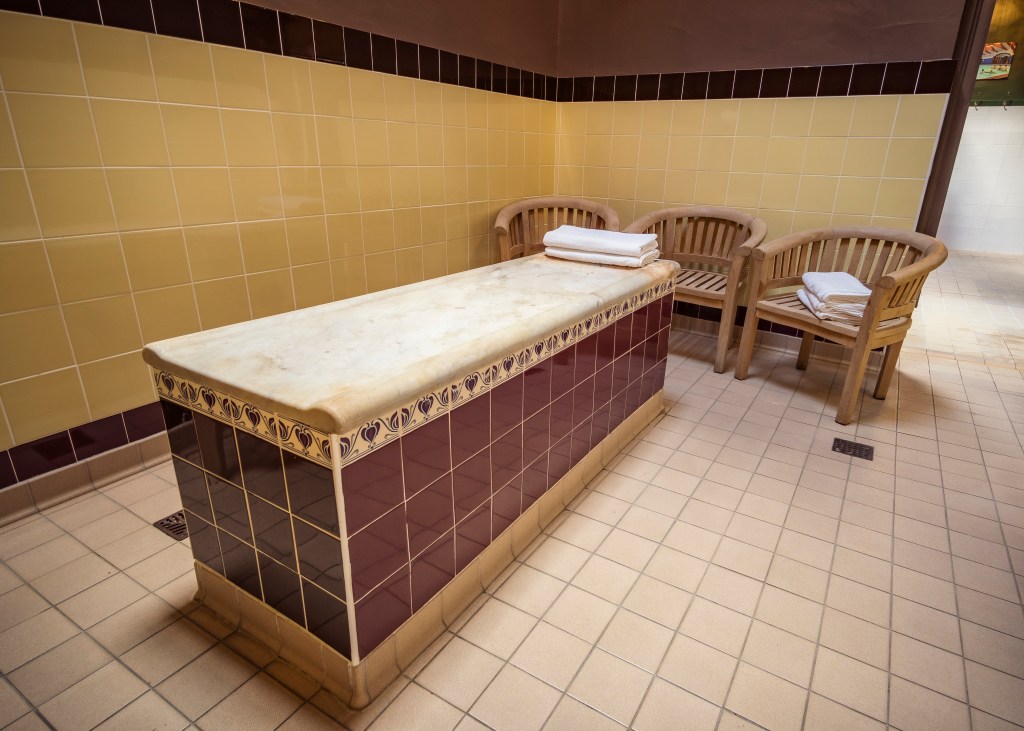
Following the shampooing they could enjoy a refreshing dip into a plunge pool, which was connected to the swimming bath via an archway, meaning they could combine their bath with a swim. And they could sit or lie in comfort in the cooling room to chat and read the newspapers until they were once again ready to face the hustle and bustle of life in Glasgow.
Researcher: Lucy Janes
Many thanks to Turkish baths historian Malcom Shifrin for valuable background information on the development, experience and culture of Victorian Turkish baths in the UK and Ireland. Lots more information is available on his website: The Victorian Turkish bath.

 Arlington Baths Club History Group