
“…a very large body of air must be thrown through the rooms to secure the requisite purity at the further end of its course, and as a natural consequence, a very great heating power must be provided to maintain the high temperatures necessary.”
John Leck Bruce, On the heating and ventilation of Turkish Baths, 1879
The essence of a Victorian Turkish bath was the circulation of heated air to create a hot dry atmosphere. In 1879 Glasgow architect and engineer John Leck Bruce described how this worked at the Arlington Baths in a paper to the Royal Philosophical Society of Glasgow.
The full Turkish suite had five rooms laid out in an upside-down T shape. These were the: cooling room, warm room, hot room, shampooing room and washing room.
A bather entered the cooling room to undress through double doors in an ornamental arched doorway. A smaller set of double doors led to a short corridor ending with the warm room straight ahead and the shampooing room on the right both accessed through heavy felt curtains. Inside the warm room, another felt-curtained doorway led to the hot room. These two rooms were divided by three arches, glazed at the bottom but open at the top to allow hot air to flow. The central window could also pivot to increase the flow.
“Under the end of the hottest room furthest from the door are placed two large hot-air stoves. Fresh cool air from openings in the basement flat passes over the heating surface of these stoves, and ascends through the grating immediately over the apparatus…”
John Leck Bruce, On the heating and ventilation of Turkish Baths, 1879
These two stoves were Constantine Convoluted or ‘gill’ stoves, invented in 1866 by the Turkish bath owners, Joseph Constantine and Thomas Whitaker. These illustrations of how they operate are from Practical ventilation and warming published by Joseph Constantine in 1881.
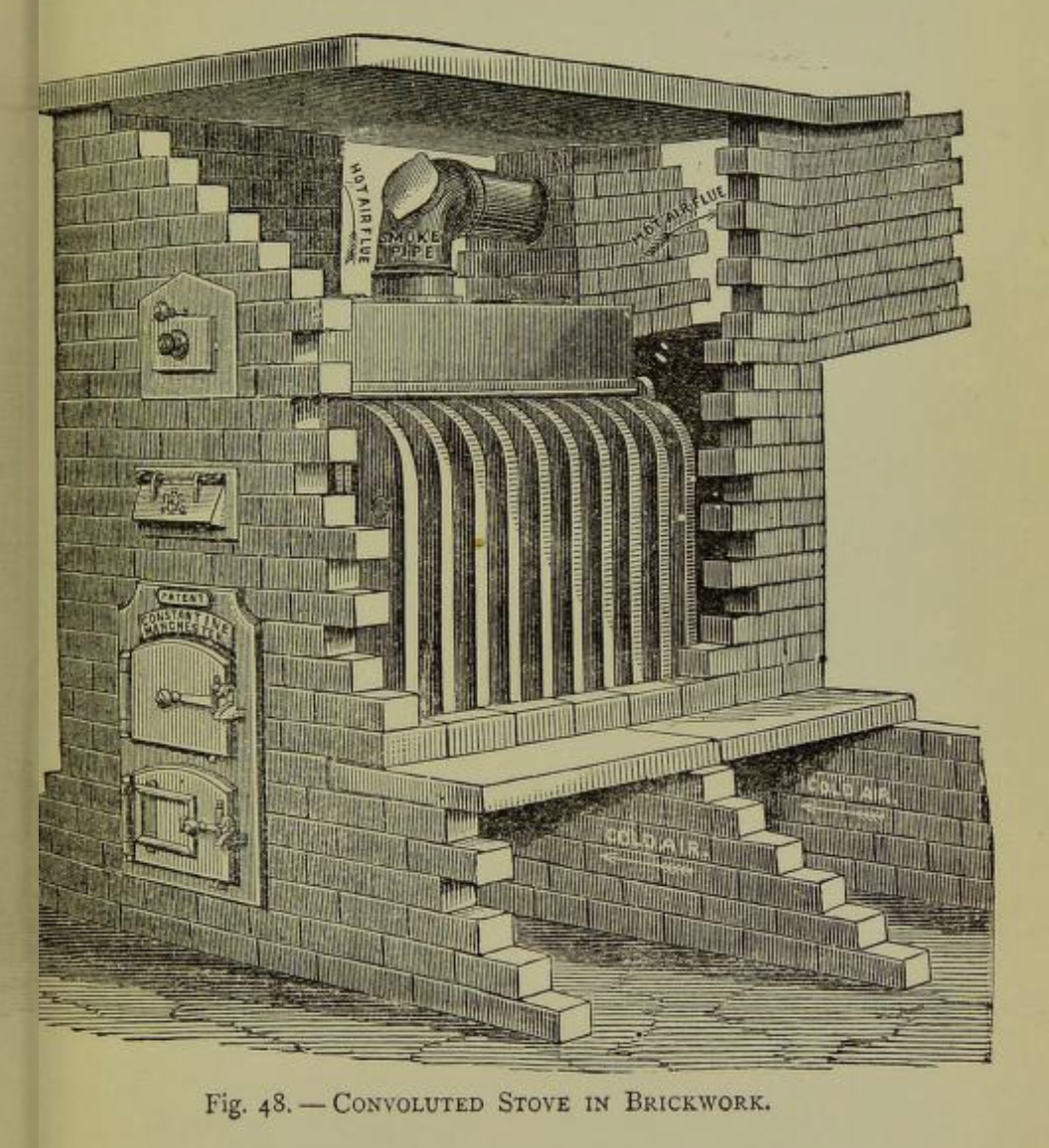
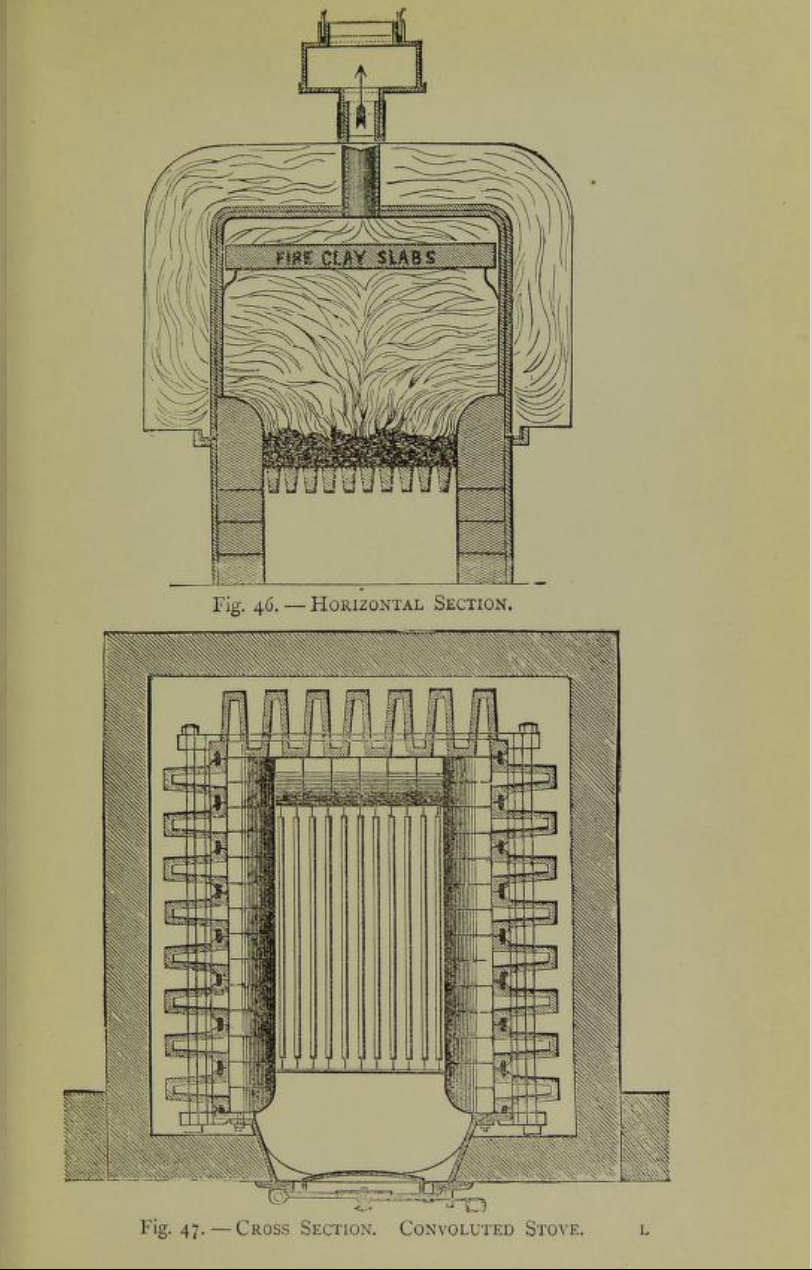
They raised the temperature of the air up to 156°C (312°F) where it entered the hot room through metal grills in the floor. The heated air then flowed through to the warm room, the shampooing room, and the washing room to eventually reach the pond hall through an opening at the top of a connecting glazed arch. The stoves used 48 to 60 hundredweight of coal to generate 55 hours of heat each week, maintaining temperatures of 99-110°C (210-230°F) in the hot room and 62°C (144°F) in the warm room, although up to 66% of the energy generated was wasted in lost heat up the chimney.
New stoves, costing £149, were installed in 1896-97 and the Turkish suite continued to be heated by coal and coke until 1950 when gas was introduced. The warm room is now kept at temperatures of around 41°C (105°F) while the hot room is at about 49°C (120°F) for today’s Turkish bathers to enjoy.
Researcher: Will Jess

 Arlington Baths Club History Group