
The former Dennistoun Baths Club building went under the auctioneer’s hammer at the beginning of 2024 with plans to convert the building into flats.
It was a swimming pool for 100 years before it closed in 1983. But where does the story of the Dennistoun Baths begin?
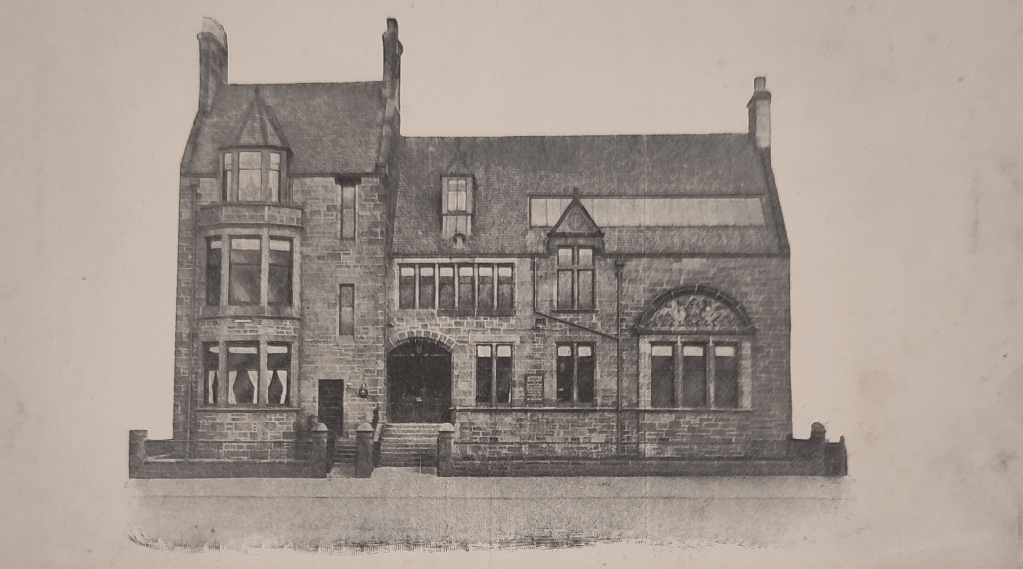
Beginnnings
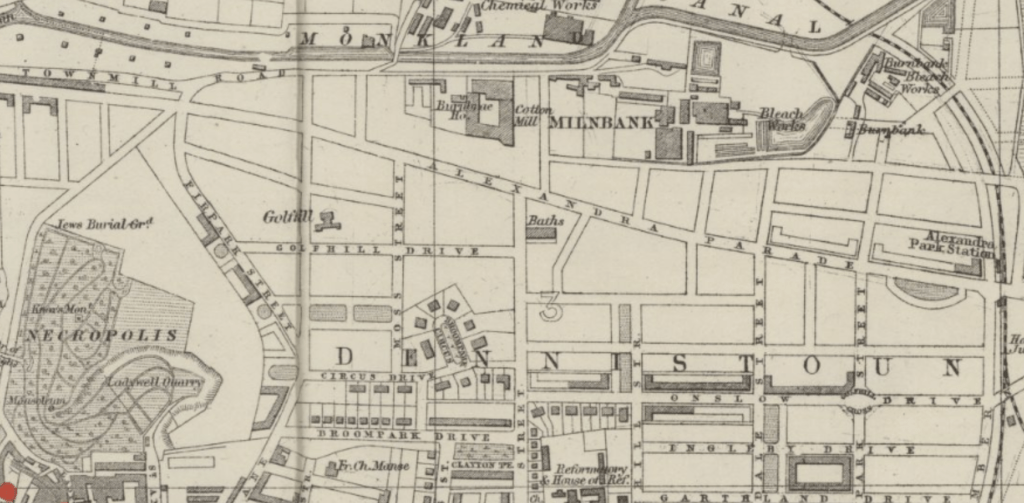
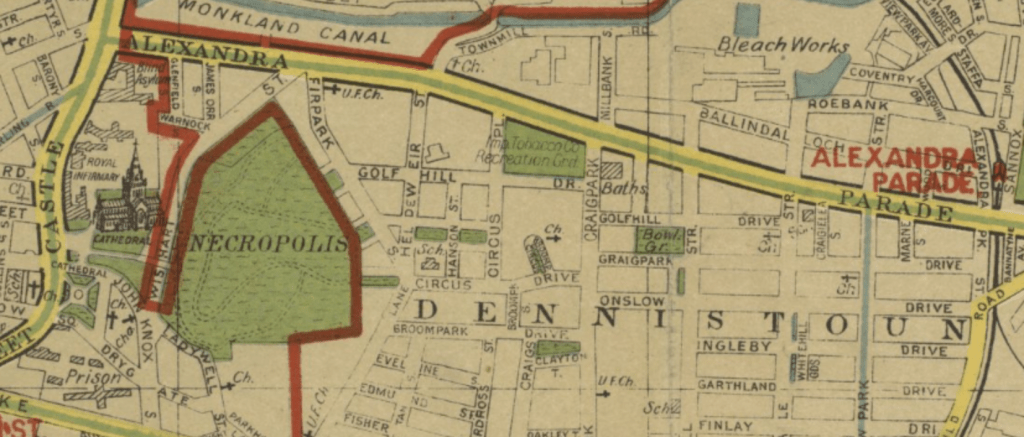
Though the Arlington Baths Club was the first private swimming pool in the city it was soon followed by similar clubs in other districts. Dennistoun Baths Club, located in the east end of Glasgow, was founded in 1883 in Craigpark, just off Alexandra Parade, and opened on 1 April 1884. You can see the Baths in the centre of this 1884 map.
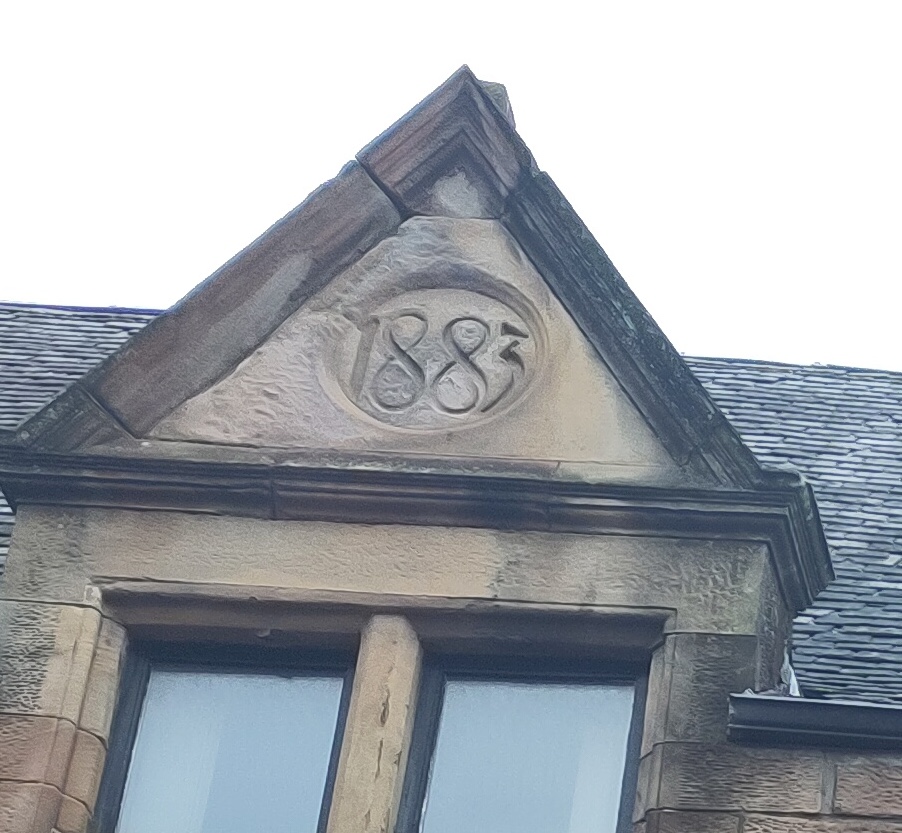
The Baths was set up, like the other private clubs, as a limited company which issued shares to raise money to construct the building. The chairman of the Baths Company was William Beardmore, a prominent businesman who suceeded his father as partner in the Parkhead Forge (in the east end of Glasgow) and in 1886 founded William Beardmore and Co. He became Lord Invernairn in 1914.
The Baths were formally opened on the evening of 31 March 1884 by Mr Dennistoun of Golfhill, presumably the son of Alexander Dennistoun who had originally granted the land for the suburb and for whom it was named. He stayed with the Beardmore family on his visit to Glasgow.
At the second annual general meeting of the Baths Company in February 1885 Mr Beardmore reported that the total costs of the building including furniture and fittings was 8,092 pounds, 7 shillings, and 1 penny. In this first year, there were 722 members including 131 ladies. (North British Daily Mail, Tuesday 3 February 1885, British Newspaper Archive). The first Bathsmaster was called John Watt.
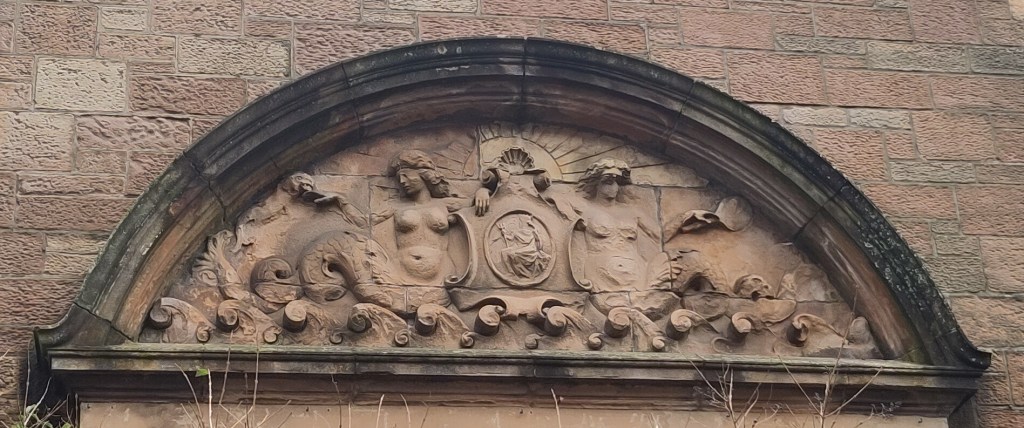
At the 1887 AGM, the Glasgow Herald reported that the Baths had 756 members who had taken 30,986 “baths” (ie swims) that year. The vice-chairman was alo mentioned in that report: Alex Paterson was, according toTemperance Standard Bearers of the Nineteenth Century (Peter T Winskill, 1897, Internet Archive), from a family who were longstanding members of the Scottish Temperance League. He was employed as the mill manager at a large clothing manufacturing business called Laird & Thomson, was connected with the Sydney Place United Presyterian Church and involved in various other social reform and local organisations.
Much of the area around the Baths was not built on for many more years. This map from 1913 shows the Victoria Cycles Works to the north of the Baths and you can see the open space around the Baths.
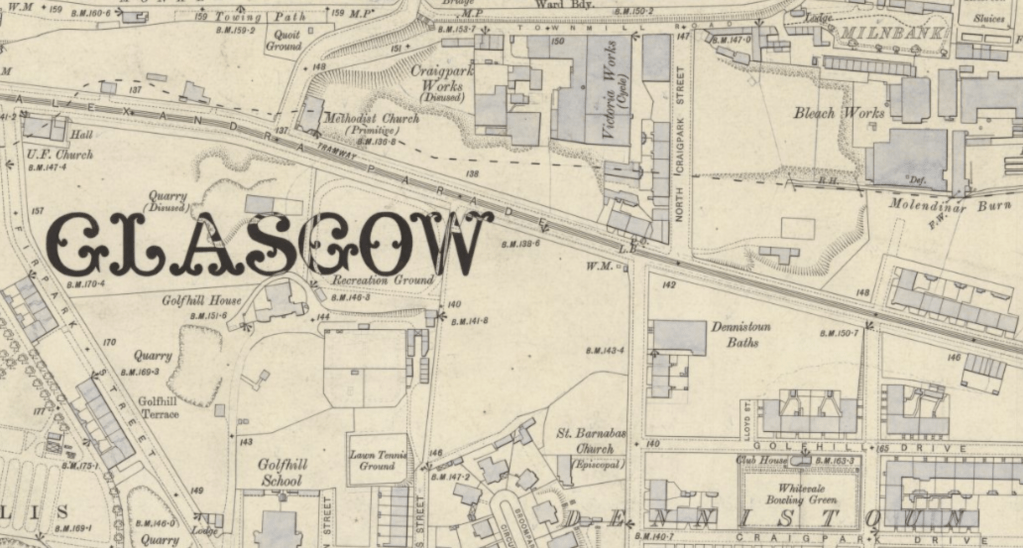
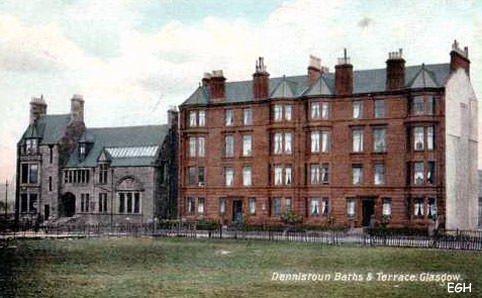
And this postcard – undated but thought to be from the late 19th or early 20th century – shows the Baths building with a tenement block beside it , which is also marked on the map above, and with open, grassy space in front of it.
Alistair Macnaughton’s father joined the Dennistoun Baths as a boy, not long after the First World War. Alistair, who was also a Dennistoun member from the 1960s onwards, remembers hearing stories from older members that these old fields around the baths were called ‘the sheepies’ because this was where sheep from farms outside Glasgow were kept to graze on the grass before they were taken down to the abbatoir at Duke Street and Bellgrove to be slaughtered for market.
Bathsmaster Berry, and his family
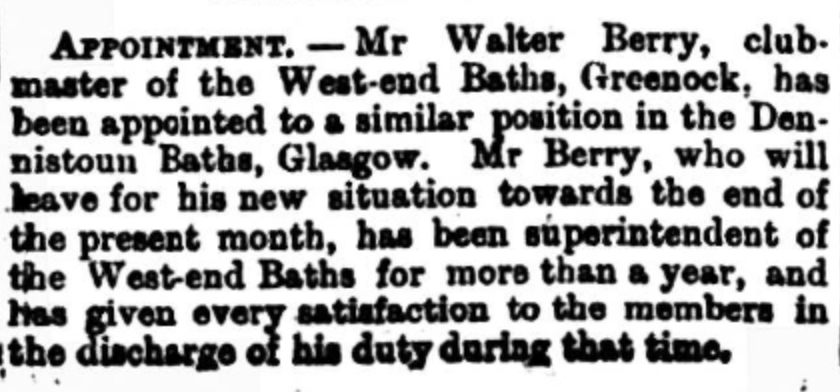
A new bathsmaster was appointed in 1887- Walter Berry – who was previously the bathsmaster at the West End Baths in Greenock.
He and his wife Mary lived on the premises in the bathsmaster’s flat which came with the job. This was a top floor flat, accessed through a ‘close’ door to the left of the main entrance. On 30 Sept 1889 Mary had a baby here – little Walter James Sutherland Berry.
The 1891 census shows the full family at the Baths on that date:
- Walter, 27
- Mary, 30
- Walter, 1
- Polly, 4
- Agnes, 46. Walter’s widowed mother
- Jessie Sutherland, 19. Mary’s sister who was working as draper’s assistant.
By 1901 Walter and Mary had a third child, daughter Jessie, aged 9, but Agnes and Mary’s sister were no longer living at the Baths. And by 1911 the family had moved away to Maryhill. Father and son were both working as drapers’ warehousemen, Mary, now 24, was a shop assistant with the Rubber Company, and Jessie, 19, was a powerloom weaver.
However there was tragedy ahead. In 1924 son Walter, who was now a clerk with the municipal services, died of tuberculosis at the age of 34 years old. His father was also deceased by this time.
Aquatic entertainments and clubs
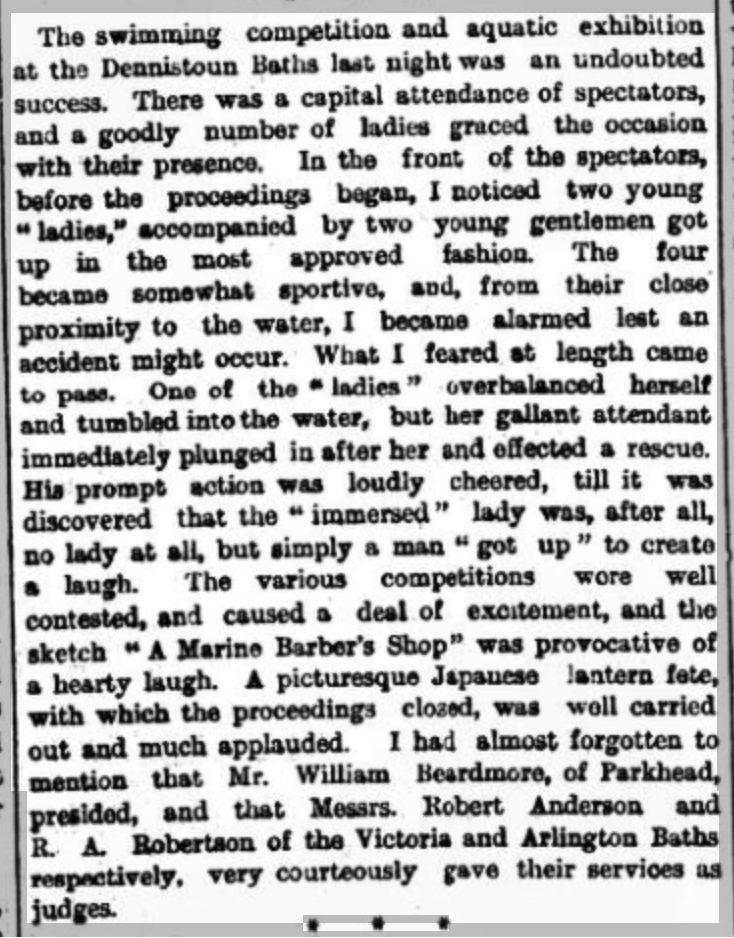
The members of the Dennistoun Baths immediately threw themselves into activities, including putting on aquatic entertainments with displays on the trapeze, races and water polo matches along with songs, music and comic sketches.
This event in October 1884 featured a man in drag ‘accidentally’ falling in the pond to be ‘rescued’ by a young man, at which the startled audence first cheered, then laughed on realising it was a jape for their amusement.
The popularity of this performance obviously prompted a repeat, for at a similar event in May 1885, following a young man’s display on the trapeze a ‘spectator’ had a go but plunged “with a howl of despair” into the water from where he was ‘rescued’. The Glasgow Evening Post described the Baths as “spacious, elegant and cleanly” with Russian and Turkish baths (Thursday 21 May 1885, British Newspaper Archive).
A report of an entertainment in April 1886 described the scene: “What with the new gallery all around the beautiful pond, the curtained off gymnasium, the large company of ladies and gentlemen filling the place to overflowing, the bright “Brush” lights, the clear platform with staging laid and diving steps removed, the tout ensemble was complete.” (The Chiel, 24 April 1866, Dennistoun Baths Scrapbook, Mitchell Library Special Collections).
An entertainment in October was described as a “tremendous success, the crush and enthusiasm being something to be remembered.” (Glasgow Evening Post, Saturday 16 October 1886, British Newspaper Archive).
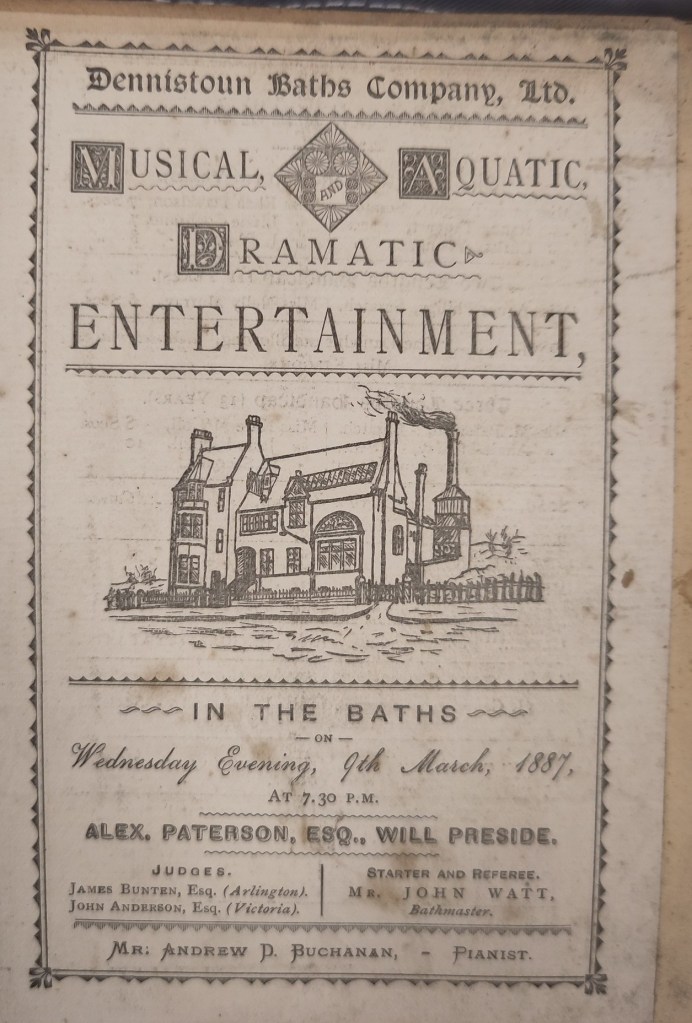
But the events at the Dennistoun Baths were not their only shows; the Dennistoun Amateur Swimming Club also performed at the opening of the arrender Baths in Edinburgh in December 1887.
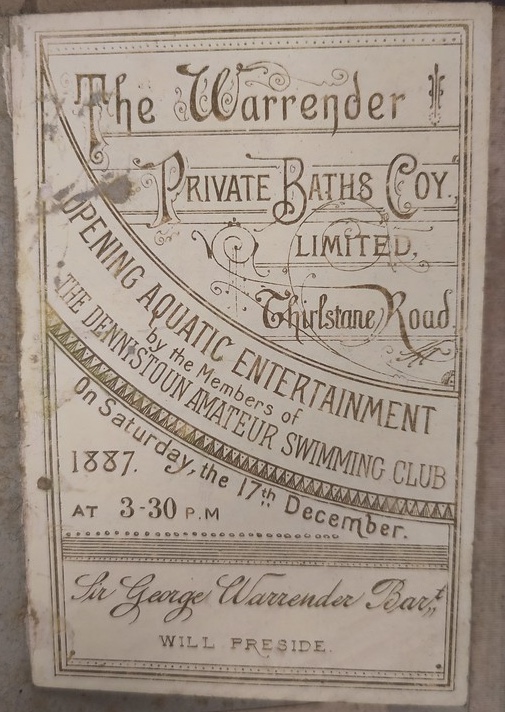
Why was this? There seems to have been a personal connection via a man called Frank Y Henderson. In 1885 he was the Dennistoun Baths secretary – his name appears in an advert for members in the North British Daily Mail (p1, Tuesday 10 March 1885, British Newspaper Archive). According to the Warrender Baths Club website, Warrender Baths was set up by members of the Bellahouston Baths in Glasgow and Frank Y Henderson.
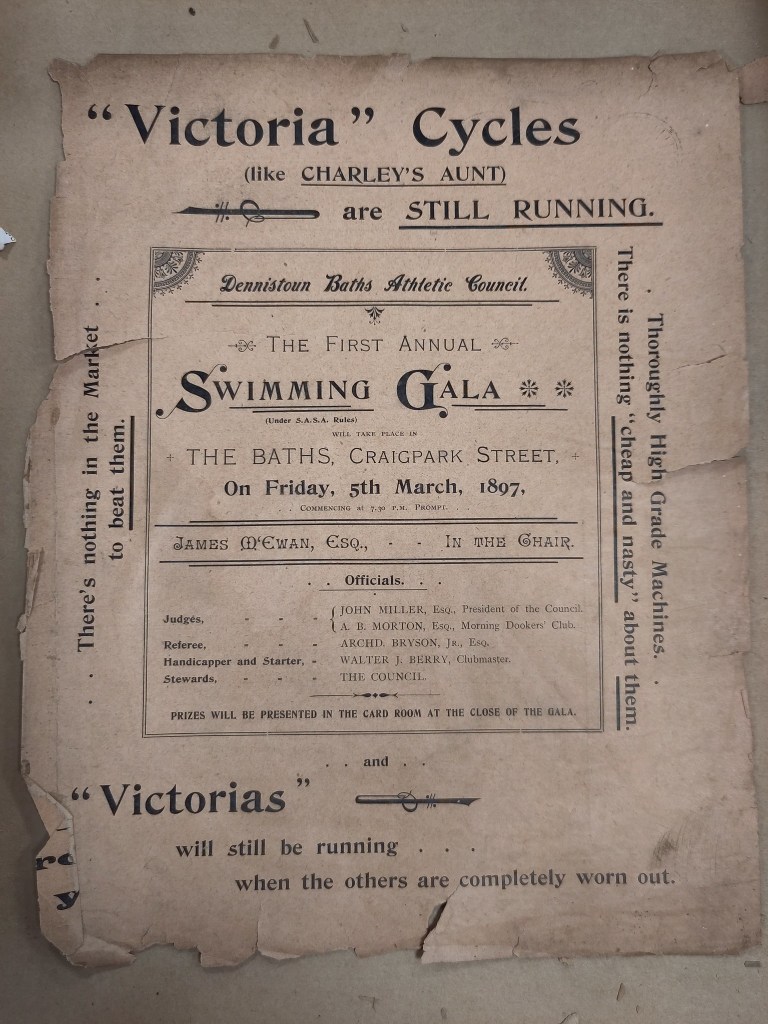
In 1897 the keen sportsmen and women of the Baths set up new club – the Dennistoun Baths Athletic Council – and held its first gala. The programme featured adverts from Victoria Cycles, a company with its works just across the road from the Baths.
The Baths were also home to the Dennistoun Harriers running club. There’s a photo from around 1900 showing a group of runners outside the Baths on The Glasgow Story website. The public baths in Glasgow also had associations with running clubs according to the Scottish Distance Running Historian who writes that “The importance of Burgh Swimming Baths to Scottish cross-country running and endurance running generally cannot be stressed too much.” (The Baths, Scottish Distance Running Historian, 23 February 2022).
And, of course, Dennistoun had a water polo team, playing against local teams from other private baths in Glasgow, and across Scotland.
Wartime challenges
Like the Arlington Baths, Dennistoun also faced challenges in the Second World War.
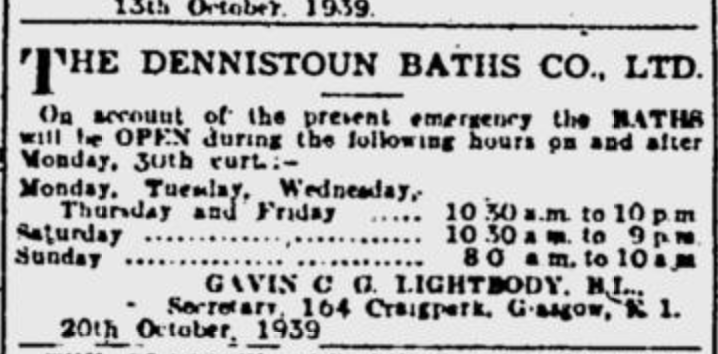
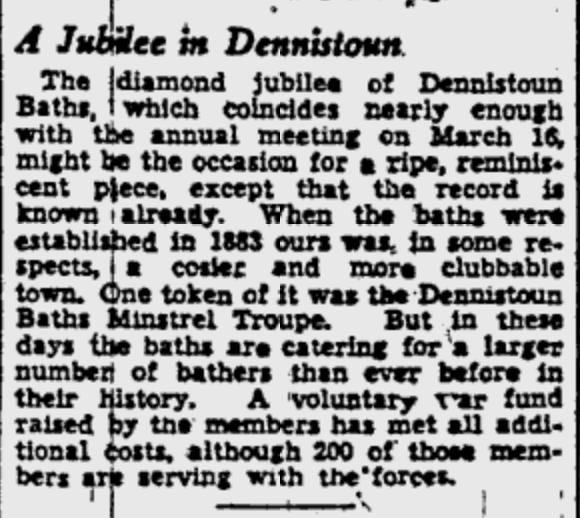
War was declared on 3 September 1939; by October the Baths had new – presumably reduced – hours. A news report in 1943 stated that 200 members were in the armed forces but that the generosity of members was keeping the Baths going, in what was its diamond jubilee year.
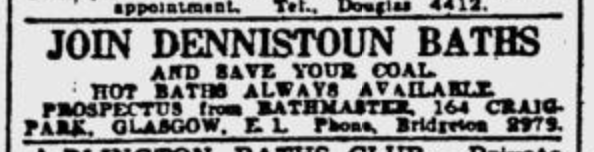
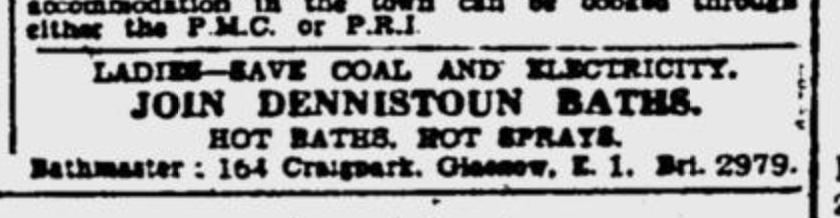
To keep up membership in 1941 and 1948 it advertised using the Baths as a way to save fuel, though in 1949 it also tried attracting more women suggesting swimming was a way to stay svelte!
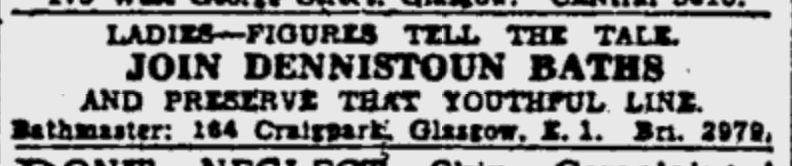
There were also other challenges. In February 1961 a re-valuation of property in the city threatened to raise the rates to be paid by the Baths from £150 a year to £2,497, which might force it out of business. Members told the Evening Times that just after the Second World War there was a financial crisis which was resolved when wealthy members contributed an additional £1000 to pay bills. A smilar crisis had also been averted in the 1930s. Committee member John Brodie explained that the Baths “is more than just a place to swim. It is almost a social centre with husbands, wives and children attending together” so raising subscriptions could drive whole families away. (Evening Times, February 24 1961, p15, available in Google Books)
But in 1965 there were still 1556 members and a new bathsmaster: retiree Thomas Clarkson Mcnab (59), a lifelong member of the Baths who had some involvement in Scottish competiton swimming, told the Evening Times, “I’m making my hobby my profession” (Evening Times , 26 Aug 1965, available on Google Books).
Former member Alistair Macnaughton’s father became the Chairman of the Board of Management, and his mother and two brothers were members. He recalls that once you’d entered through the front door there was a vestibule, then you were right into the pool hall and turned right into the changing rooms. There was a pants room at the side of the pool where the male swimmers picked up their swimming trunks (pants) and a towel.
“…the pool was the centre of the Baths… Then to the right hand side were the changing rooms, hot rooms, steam room, gents showers, a lot of cold sprays… like circular sprays. ….we had a glass roof over the pool, so it was nice natural sunlight. The gymnasium was at the top of the pool; it was kind of one room, all open plan. If you looked up the pool, at very top in the middle was the dial. And then there was an area of five metres behind that, a tiled area, then straight into the gym. When you came into the the actual baths itself, you went up the staircase on the left-hand side to go up to the balcony at the top, where people used to sit and watch the galas or polo matches. That was on the Craigpark side,…and then on the other was the boardroom, was a card room, and there was a snooker room. There were two snooker tables…”
Alistair Macnaughton, former Dennistoun member, oral history interview
The boardroom and card room were underneath the bathsmaster’s flat – which was still offered free as a perk of the job – but were only accessed from inside the main building.
The pool had a springboard and diving dial (platform) but no trapezes or travelling rings.
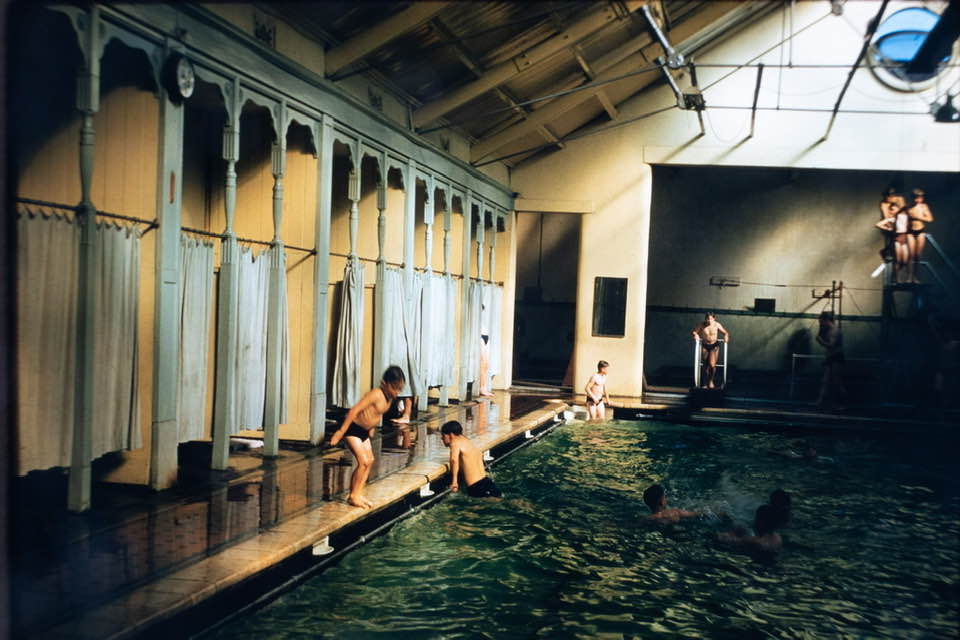
“It used to be a bit of a rammy in the pool… You can see the number of people, the number of kids that were in that pool queuing up on the dial. How nobody fell and hurt themselves…?!”
Alistair Macnaughton, former Dennistoun member, oral history interview
Changing times
As Dennistoun changed it became harder to attract members and keep up the income needed to keep the Baths running. Local schools paid to use the pool and a contributor to the Urban Glasgow online forum recalled going there for swimming lessons: “I left Whitehill school, (the old one!) in 1973. The School didnt have a swimming pool, so every week we would trek up to ‘Denny’ Bath.” (Ian_ Inaz, on urbanglasgow.co.uk, July 8, 2012).
Another 1970s money-spinner was the bar, opened as part of a deal with Tennent’s Brewery in Drygate which also brought in new members as the Baths offered the brewery employees a discount to join. But by the early 1980s the Baths could no longer keep going.
So what happened really, was when when the oil prices took a real hike, it just caught the Baths out and because we were on the wrong side of town, if you like – people were moving from Dennistoun… into the West End or the Southside. And because of that there was a lack of the type of people that we wanted… fewer people that wanted to pay a subscription to join a private baths. And that really was what killed us…”
Alistair Macnaughton, former Dennistoun member, oral history interview
By now Alistair himself was on the Board and part of the team that had to wind up the Baths, which was still operating as a limited company just as it had been set up 100 years before, and sell the property.
When the Baths closed, we had enough money to pay everybody that we owed money to. And there was no point in continuing the situation till we couldn’t afford to do that. So the decision was made by the Board to close and we sold the Baths to that snooker club. But everybody, everybody – there was no money left over for the directors, but anybody that was owed money was paid.”
Alistair Macnaughton, former Dennistoun member, oral history interview
Dennistoun Baths closed its doors for the last time in summer 1983. But the Dennistoun members were invited to join the Arlington Baths.
Here’s the letter that Arlington Baths Club chairman Kenneth Fettes sent to the Secretary of the Dennistoun Baths, along with information about the cost of subscriptions, and the facilities that members could enjoy.
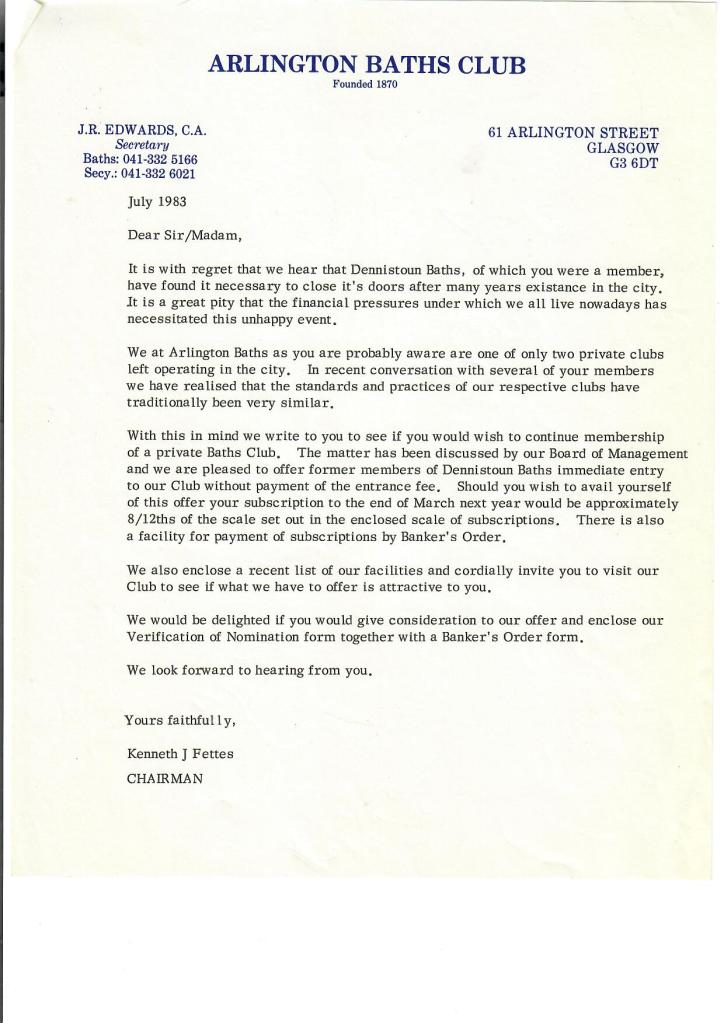
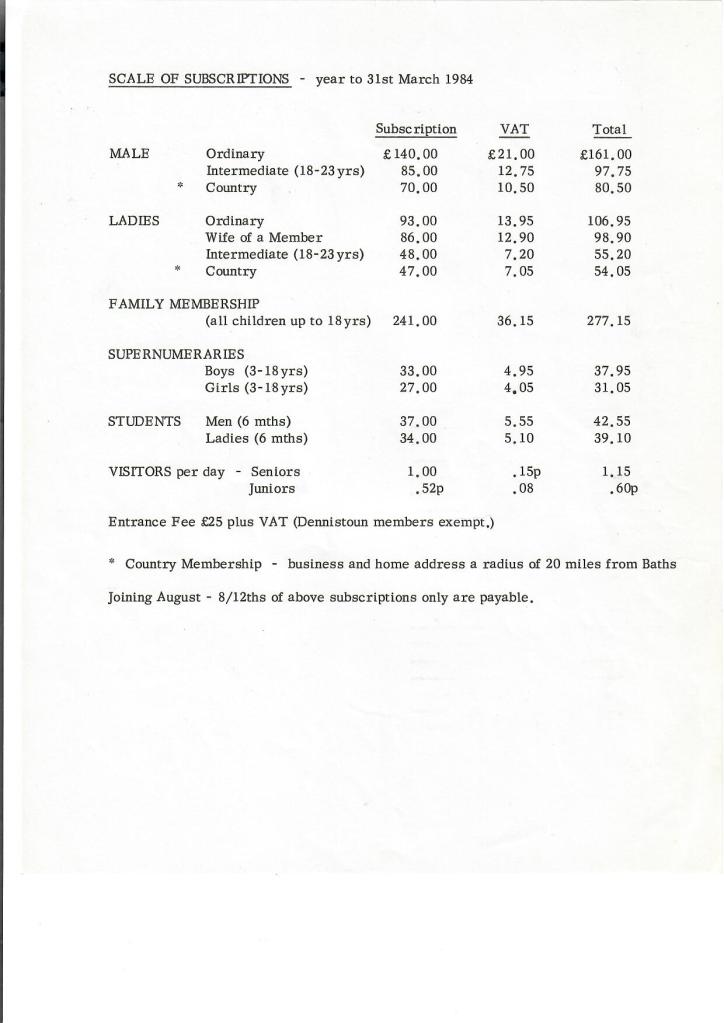
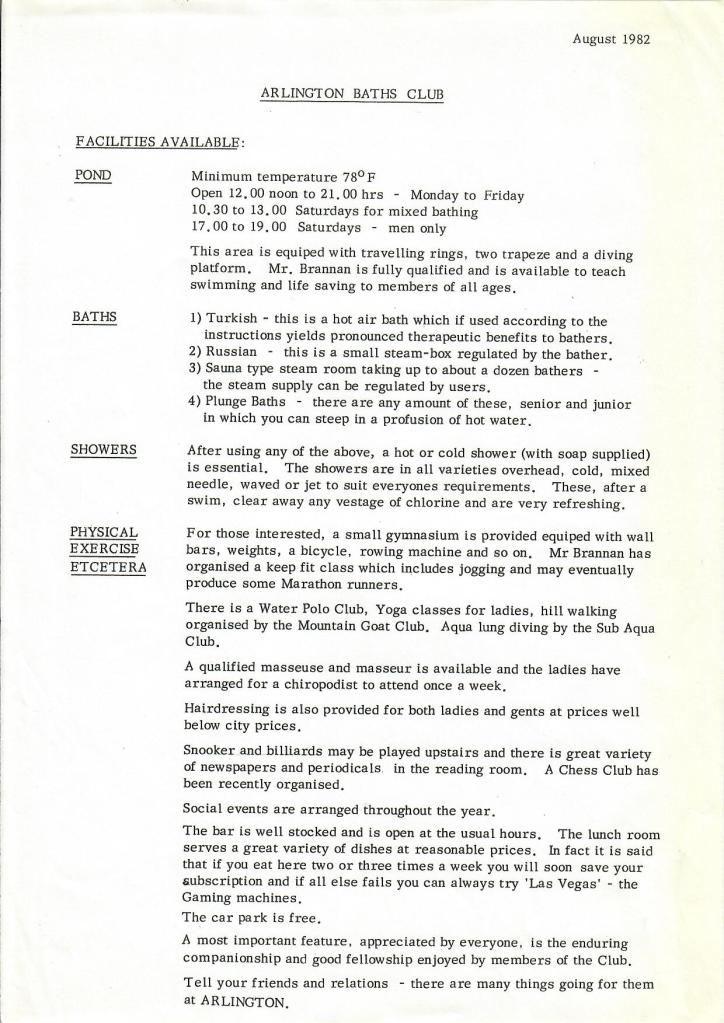
A number of Dennistoun members joined the Arlington Baths, including Alistair McNaughton, who has now given many years service as a member of the Arlington’s Board of Management.
After the swimming stopped
The Dennistoun Baths building was converted to the Craigpark Masters snooker hall in the 1980s. The pool was filled in and a modern extension built over the space to house the snooker tables.
Contributors to the Urban Glasgow online forum have shared their recollections of the changing building:
“The words DENNISTOUN BATHS were painted in large white letters on the gable end facing towards the [Alexandria] Parade.”
Sydney Rosewater, UrbanGlasgow.co.uk, Jan 5, 2010
I stayed around the corner in whitehill st in 81 & remember me & a few pals got into the building one night soon after it closed down, i can confirm indeed that there was a swimming pool, i nearly fell into it when it was empty as it was pitch black inside… also remember seeing the extension getting knocked down & the pool full of rubble.”
Stevie, on urbanglasgow.co.uk, Jun 26, 2012
Just to set the record straight about the date the snooker club opened, it was in June 1987. The reason I’m sure is I used to play snooker, and I moved clubs from the Davis Club in Argyle Street to The Masters when it opened. The owner of the club at the time, Tommy Heenan, who sponsored me for a couple of years, was part of the Heenan family, who, if IIRC [if I recall correctly], received about [£]1m when they sold the La Cala pub just off Alexandra Parade to Tennents the same year.”
The Duke, UrbanGlasgow.co.uk, Jan 8, 2010
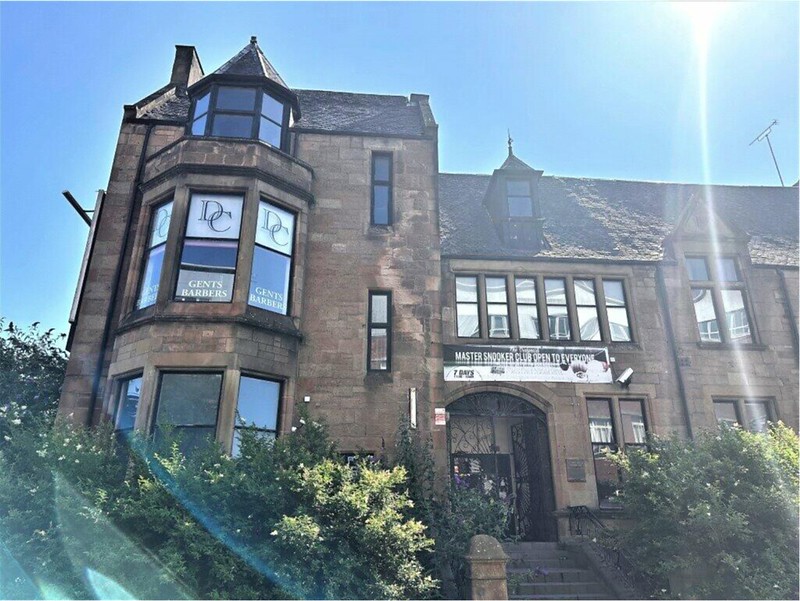
The snooker club continued until the COVID-19 pandemic of 2020/2021 but did not re-open after the pandemic closure. The building was sold at auction in January 2024.
Glasgow City Council has given planning permission for the B-listed building to be turned into flats, five in the old building and six more in a new extension at the back replacing the current modern extension that houses the snooker hall.
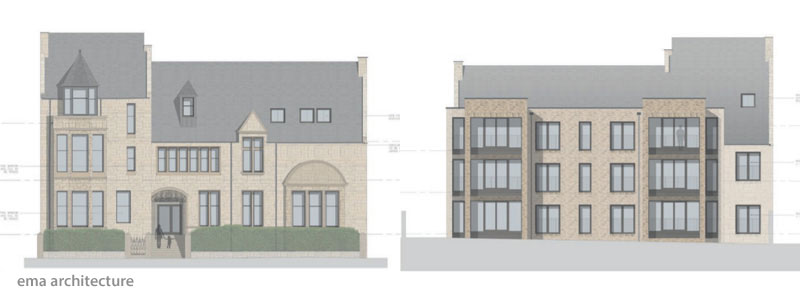
Update: In April 2024 a new planning application was submitted by a different company working with MAC Chartered Architects, this time to convert the building to eight flats, and create a car park at the back of the building in place of a new extension. As of April 2025, the application was still under consideration by Glasgow City Council.
Were you ever a member of the Dennistoun Baths? Do you, or your friends or family have memories of the Baths building and the swimming community there?
We’d love to learn more! Please share your recollections in the comments!
Researcher: Lucy, with help from the rest of the History Group, and Alistair Macnaughton.

 Arlington Baths Club History Group
A fabulous account of the “Denny Baths”. Well Done.
I remember going there many a time: eventually getting my “Award of Merit” Life Saving medal there. That was around 1959, whilst I was a pupil of Whitehill Senior Secondary School.
LikeLike