
William Wilson was the the first Bathsmaster at the Arlington Baths. He was well known, not only a swimming teacher, but also a vocal advocate for the art of natation.
He and his wife Ruth came to work at the Baths to manage the facilities and teach swimming. Ruth taught the ladies, and possibly was the first female swimming teacher in Scotland. We think they lived in a flat in the basement!
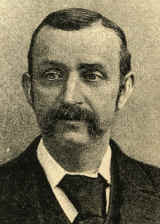
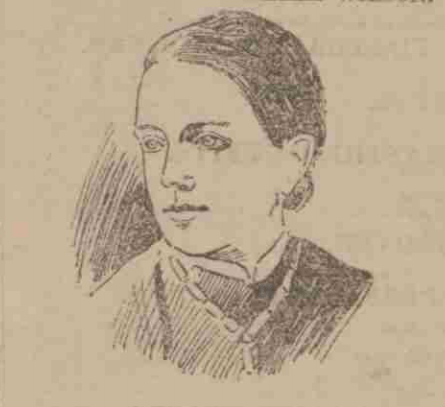
As well as managing the Arlington Baths and then moving to manage the new Victoria Baths on the Southside of Glasgow, William Wilson wrote books about learning to swim and published journalism to promote swimming and lifesaving.
Indeed, this activity ended up in a media spat…!
Tragedy at The Gareloch
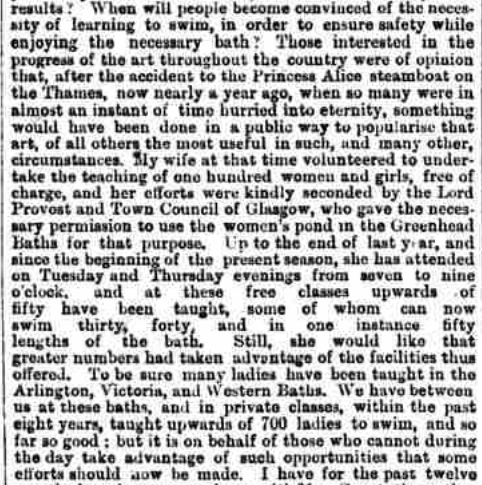
In July 1879, following the drowning of two young women at the Gareloch, Mr Wilson wrote to the North British Daily Mail to urge the necessity of people learning to swim, including women. he also referenced the sinking of the Princess Alice paddle steamer the previous year, an accident which led to around 650 people drowning in the polluted waters of the Thames.
Mr Wilson said that his wife had volunteered her services and taught 50 women to swim at the Greenhead Baths, run by the Glasgow city corporation, some could now swim 30, 40 or 50 lengths. He added that over the past eight years he and Ruth had taught around 700 women to swim.
“Up to the end of last year, and since the beginning of the present season, [my wife] has attended on Tuesday and Thursday evenings from 7 to 9 o’clock, and at these free classes upwards of 40 [ladies] have been taught, some of whom can now swim 30, 40, and in one instance 50 lengths of the baths.”
He went on to explain that he was developing a scheme whereby:
“…hundreds of women and girls engaged during the day in warehouses, workrooms, and factories would learn and benefit by the exercise of swimming. It would be to them a sanitary boon, a healthy exercise, and a necessary accomplishment, as being the means of saving their own and it may be the lives of others in cases of emergency.”
Figures under fire
But his claims were disputed by the the new bathsmaster at the Arlington Baths, a Mr R A Robertson who was also the Honorary Secretary of the Associated Swimming Clubs of Scotland. He suggested that it wasn’t possible for the Wilsons to have taught so many women to swim in the time stated.
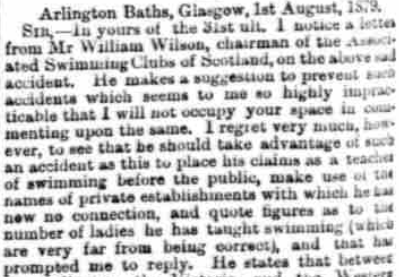
Furthermore he doubted that anyone who had only recently learnt to swim would be able to complete the distances Mr Wilson had quoted.
“I am not inclined to believe such a distance being swam by anyone so recently taught swimming, and will be glad to present any pupil in this class swimming 30 or 40 lengths with a silver medal, and any pupil doing 50 lengths with a gold medal.
“I will place the same in the hands of the chairman of the Public Baths Committee any day within the next fortnight if accepted, and have written Bailie Wilson to this effect.”
The Wilsons fight back
But Mr and Mrs Wilson did not take this lying down. Mr Wilson responded to the letter by replying to the Glasgow Herald saying
“I would much rather have treated it with the contempt that it deserves than enter seriously into its details, but as you have given it publicity, I have no doubt but you will also afford me an opportunity of putting myself right with those that have read it.”
He then went on to explain his figures for the numbers of women taught, and defended their abilities in the water.
“Disbelief is next expressed as to the distance swam by some of these ladies. That such results should so bewilder Mr Robertson shows on his part an amount of ignorance of his business as a teacher of the art that he ought to be ashamed of. I have yesterday, and today seen three of the youngest misses in these classes, all members of different families, swim 54 and 56 lengths of a bath, six feet longer than the pond in the Greenhead Baths, and with the greatest of ease; so Mr Robertson had better set his goldsmith and silversmith agoing, for I have letters from others ambitious to possess trophies of their powers in the water at this cheap rate.”
William Wilson, letter to The Glasgow Herald, 12 August 1879
A public contest
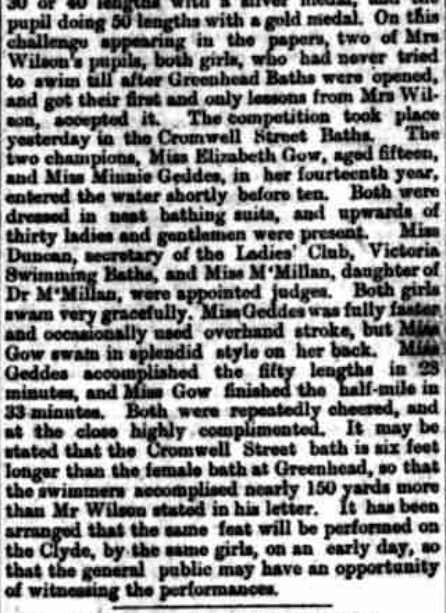
Following this spat, two of Mrs Wilson’s pupils took to the water to prove they could do what was claimed. A contest was arranged at the Cromwell Street Baths. This was a private swimming baths situated just a few streets away from the Arlington Baths.
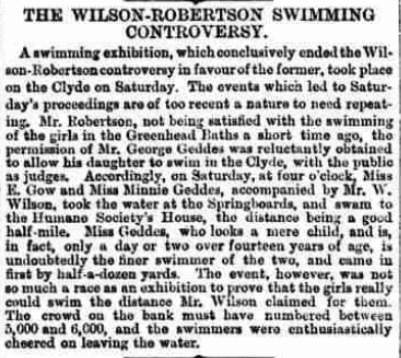
The swimmers were Miss Elizabeth Gow, 15, and Miss Minnie Geddes, 14. Minnie was the daughter of George Geddes, who became the second officer of the Glasgow Humane Society in 1889 on the death of his father, also called George Geddes. the Glasgow Humane Society was founded in 1790 to rescue people at risk of drowning in the River Clyde, and it is still operating today.
Around 30 ladies and gentlemen were present and two women were appointed judges.
Minnie did the 50 lengths in 23 minutes and Elizabeth finished in 33 minutes. And it was pointed out that the pool was actually longer than Greenhead Baths where the women’s pool was only 40 feet by 20 feet, so they had actually swum nearly 150 yards than they were used to.
In fact everyone was so impressed by their achievement that they were prevailed upon to do it again, this time in the River Clyde, apparently over the reluctance of Mr Geddes. Mr Wilson swam with them, and a crowd of 5-6,000 people cheered them on!
An inspiring story
The Wilsons continued to teach in Glasgow and campaign for everyone to learn to swim. We have a lot more to learn about their lives and work.
Mrs Wilson died in 1899, and in an obituary in the Scottish Referee was described as the “first female teacher of swimming in Scotland, having been appointed to the Arlington Baths Ladies Club in 1872”.
At the Arlington Baths today, we were so inspired by this story that – thanks to generous funding from Sporting Heritage – we created our own dramatisation of the events!

- Researcher: Will Jess
- Script and blog: Lucy Janes
- Filming and editing: Jon Oates
The creation of this film was generously funded by Sporting Heritage, which brings together the UK’s sporting collections and the people who care for them.

 Arlington Baths Club History Group